


What drives car advertising
Having worked on automotive accounts in various agencies as a creative, there are elements in this versatile field of advertising that are recurring for all of my briefs. Here are some of these elements:
Status vs Commodity
The focus tends to be on rational and functional benefits for small cars. For family and high-end models, the differentiation lies increasingly in the emotional pay-offs.
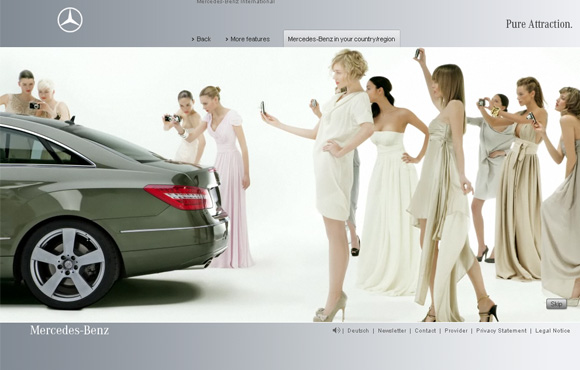
Mercedes Benz’ "Objects of Desire" campaign by Scholz & Volkmer follows all guidelines for contemporary advertising. It carries a headline conveying a costumer benefit, contains a large product shot so you know what it looks like and it contains a series of little captions. Words and sentences are arranged in some grammatical order giving useful information about what the product does.
Exclusive vs Elusive
Think of commodity and then about a luxury car. How much it collides with emotional drives comes across perfectly with what Maserati did in their campaign "Is your garage worthy" (2009). Take away rational elements not only from cars but also their environment, putting the product into context. The garage becomes a temple, a fashion accessory. This cross branding approach of Maserati collaborating with Architectural Digest is common. Subaru and DC shoes are taking my previous claim "fashion accessory" quite literal in their campaign with drift driver Ken Block (2009). In the highly stylised infomercial the images of the shoes and the car create a fuddling atmosphere of extreme sports. Rubber burns and paint drips. Referencing extreme-sports like drift driving and skating as well as graffiti and paint-balling appeals undeniably to young audiences and men in their midlife crisis.
Being Green vs Being Mean
Arnold Schwarzenegger known for equipping his Hummer H1 with an environmentally friendly engine struggles to sell his environmental concerns credibly. When it comes to making compromises, such as selling the Hummer for a Saab, environmental concerns come to their limits.
Left Brain vs Right Brain
We often try to rationalize our decisions, subconsciously acknowledging that the real reason lies deeper. Nobody buys an SUV for driving off-road or through 30 inches of snow (at least not in London) but we argue that we could, if we wanted to or had to. The same accounts for cars that can (theoretically) drive 200 miles per hour. If you’re not in easy reach of a German autobahn the pleasure will be left to others. And still the perception of a Ferrari in terms of its design and performance, cost of ownership, sales and after-sales all impact upon the purchase decision.
Space and fuel efficiency are some of the generic benefits that rationalize a purchase. However, with too many new models released in September of every year, car-manufacturers differentiate on the emotional pay-offs. Emotional drives (procrastination) arguably biases our decision-making.
Two premium brands competing for the same segment. BMW and Audi with an unconventional advertising approach.
© Flow Bohl 2009


Resources
Web Site Design & Art Direction
Micro Site Design & Art
Direction
Email Design & Art Direction
Online Banner Design & Art
Direction
Design & Art Direction
for Flash Games

Industries
Automotive Online AdvertisingLeisure & Entertainment Online Advertising
Beverages & Food Online Advertising
Fashion & Retail Online Advertising
Cosumer Products Online Advertising
Mobile Online Advertising
Travel Online Advertising
Finance & Insurance Online Advertising
Articles
10 Benchmarks for online marketingMemorizing advertising
What drives car advertising
Referrals
Hairdresser LondonBridal Hair Style
