


Memorizing advertising
Making a friend for life or proclaiming your existence? A brand’s responsibility is to maintain a customer relationship. Customer ownership and branding follow the same principle. It’s not a secret that customers don’t buy products or services. They buy brands. That’s why memorable advertising campaigns have a significant impact on a brand’s success.
 Aquiring information happens both consciously and subconsciously.
Storing information that can be reproduced is what learning as memorizing
does. Branding deals with the concept of unconscious learning, not being
aware of having stored information.
Aquiring information happens both consciously and subconsciously.
Storing information that can be reproduced is what learning as memorizing
does. Branding deals with the concept of unconscious learning, not being
aware of having stored information.
Association
We remember information through association. I.e. an apple: green, round, tree, fruit we connect a piece of data with another. When we see images, hear sounds, smell scents we create an association with other pieces of data. It helps us to be able to store high volumes of information most efficiently.
Associations are different for each person depending on socio-cultural environments and personal experiences. An image of a dog might evoke sympathy for someone and fear for someone else. Using universal signs and associations that are socially and culturally neutral might therefore have the highest chance to be interpreted as intended.
For your brand all senses compliment each other in bulding associations. The sound of a car's engine as well as the smell of it's leather interior or it's design.
Once the information is stored a continuous representation keeps the memory present. In graphic design it is a rigid visual continuity which brings us to the next point.
Repetition
Play it again Sam. Again and again, helping us to memorize, storing information in our long-term-memory.
For example in web sites where navigation elements change position and wording for each page create confusion as an initial page layout creates expectations where to find relevant information for following pages.
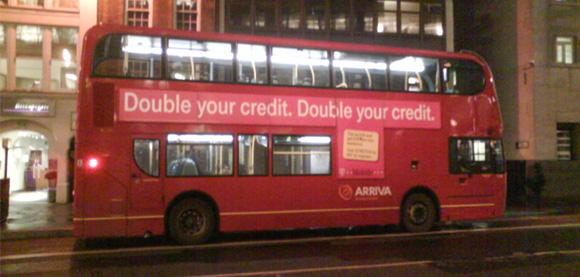
Have a look at Double Your credit bus-adverts from Saatchi&Saatchi London using repetetive messages and iconic brand-colors. (Pardon the bad quality of the picture - that's all my camera phone can get)
Copying
I’m not talking about theft of intellectual property but inspiration. It sounds better but more importantly it has a different effect. Inspiration starts with copying and leads to developing given elements further. Before writing a poem everyone has to learn how to write. Normally that happens by copying the shape of a letter repetitively until you remember it. Copying can also be found in behaviour, like social conventions or traditions. We behave in certain patterns to blend in or gain personal advantage. A contemporary example would be “flash-mobs”. They are organized gatherings of random people (normally youths) for a brief time, normally in public hot spots.

Flash mobs gained major attention in advertising the first time 2009 with T-Mobile’s campaign “double your credit” as a follow-up of their “dance” campaign a year earlier from Saatchi & Saatchi London. The “dance” campaign staged in Liverpool Street Station in London became #1 viral in the internet April 2008.
Large groups of people draw attention and have an impact on our decision-making. In behavioural economics referred to as irrational behaviour. A good read on this topic is “Predictably Irrational” by Dan Ariely.
But it doesn’t end there...
Writing
Writing goes beyond working memory and helps storing information in the long-term memory. In online marketing it’s achieved through user-generated-contents (UGC), having customers writing product reviews or discussion boards.
The relevance for brand relationships and learning: Learning creates awareness and awareness creates familiarity. We trust things we are familiar with. Familiarity sets benchmarks for what awaits us, for what we can expect. And expectations will always lead to biased real-life experiences.
© Flow Bohl 2009


Resources
Web Site Design & Art Direction
Micro Site Design & Art
Direction
Email Design & Art Direction
Online Banner Design & Art
Direction
Design & Art Direction
for Flash Games

Industries
Automotive Online AdvertisingLeisure & Entertainment Online Advertising
Beverages & Food Online Advertising
Fashion & Retail Online Advertising
Cosumer Products Online Advertising
Mobile Online Advertising
Travel Online Advertising
Finance & Insurance Online Advertising
Articles
10 Benchmarks for online marketingMemorizing advertising
What drives car advertising
Referrals
Hairdresser LondonBridal Hair Style
